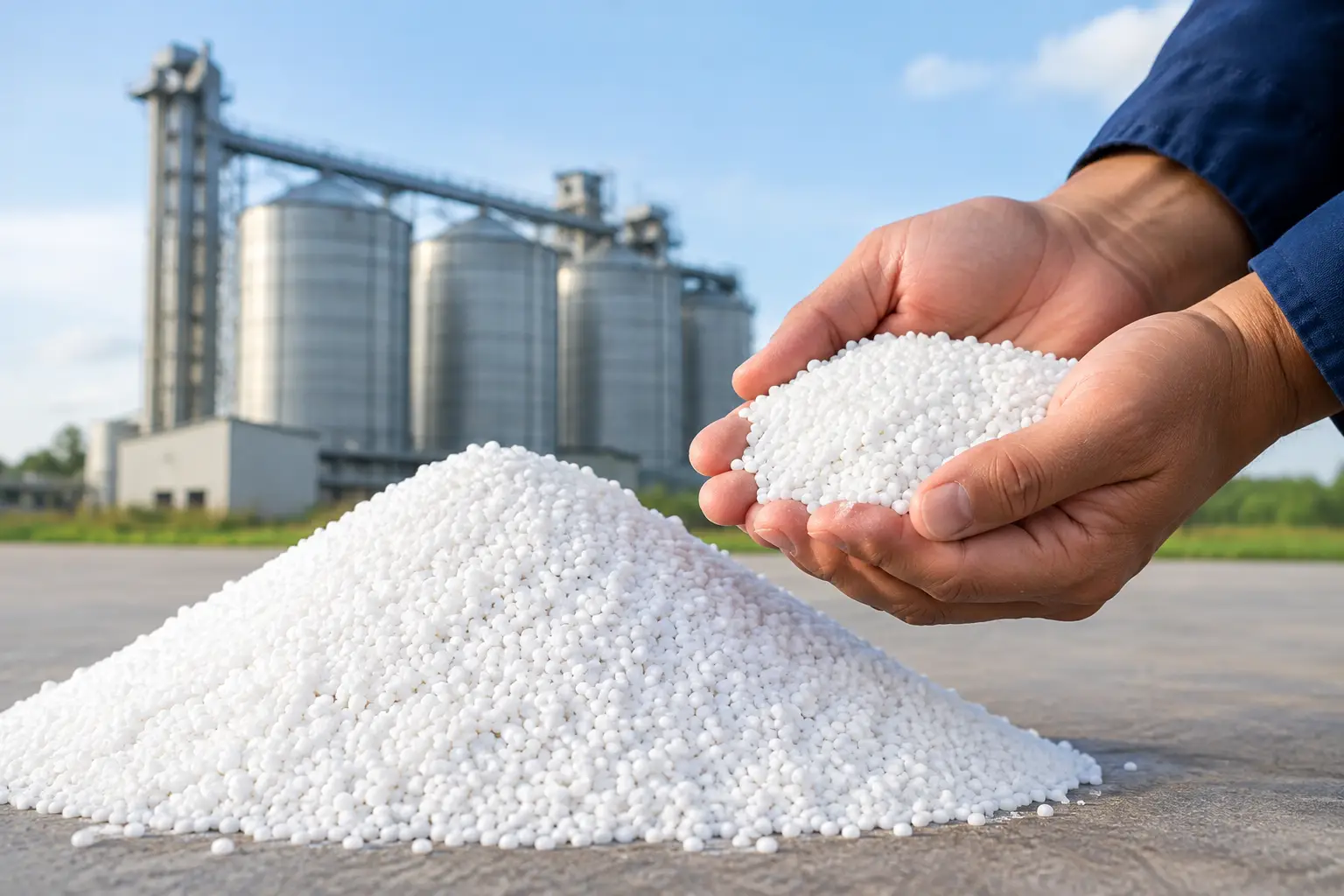

A DEF manufacturer cannot correct unsuitable urea once it has entered the production system. A low purchase price offers little value if excessive biuret, insoluble matter or unverified handling creates filtration losses, off-spec batches or customer claims. This DEF sourcing example shows how a commercial buyer can qualify low-biuret urea for predictable Diesel Exhaust Fluid production, from the initial enquiry through to delivery at a named UK port or warehouse.
The principle is straightforward: buy a defined technical grade against an agreed specification, not simply a commodity described as urea. Product quality, packaging integrity, documentation and landed delivery cost all need to be assessed together.
The DEF sourcing example: a typical buying requirement
Assume a DEF producer requires 500 metric tonnes of urea each month for a facility producing aqueous urea solution for road-freight, agricultural and off-road diesel applications. The manufacturer blends urea with demineralised water to produce Diesel Exhaust Fluid containing 32.5% urea by mass. Its immediate requirement is continuity of supply, but it must also protect compliance with the applicable ISO 22241 requirements and the performance of its filling and filtration equipment.
The procurement brief should state that the material is DEF-grade or technical-grade urea intended for Diesel Exhaust Fluid processing. It should not request standard fertiliser urea as a substitute. Both materials may be described as 46% nitrogen urea, but their suitability depends on impurity control, handling history and supporting evidence.
For this example, the buyer sends a request for quotation containing the monthly and annual volume, preferred delivery window, destination, packaging requirement and quality criteria. The buyer specifies low-biuret urea, free-flowing product, and batch-level documentation. A realistic request also identifies whether the material will be dissolved directly on site or transferred to an intermediate warehouse before production.
That level of detail allows suppliers to quote the correct material and logistics route. It also avoids a common issue: comparing a bulk fertiliser offer with a bagged technical-grade offer as though they are like for like.
Define the quality standard before comparing prices
DEF production requires high-purity urea handled in a way that avoids contamination. The buyer should identify the applicable version of ISO 22241 and set acceptance limits in its purchase specification. The urea certificate of analysis should support those limits, while the DEF manufacturer remains responsible for validating its finished fluid.
The specification normally considers urea content, biuret, moisture, insoluble matter and contaminants that can affect selective catalytic reduction systems. Trace metals, phosphates, aldehydes and other unwanted substances require particular attention. A supplier declaration without analytical support is not the same as a documented technical-grade supply programme.
Biuret is a useful early screening point. It is formed during urea manufacture and can be acceptable at higher levels in some agricultural uses, yet DEF production demands tightly controlled material. The buyer should therefore request the stated maximum biuret content, the typical analysis, the test method where relevant and the certificate of analysis for the offered lot.
Particle form matters operationally as well. Prilled urea generally dissolves quickly and may suit controlled solution preparation. Granular urea can be appropriate where the processing system has sufficient dissolution time and filtration capacity, provided the grade meets the required purity specification. The correct choice depends on the plant, not on a general claim that one form is always superior.
The purchasing specification should also make clear that product must be clean, dry, free-flowing and protected from cross-contamination. DEF-grade urea that has been stored beside fertiliser products, exposed to water ingress or moved through unsuitable equipment can create a risk even where the original factory analysis was satisfactory.
Documentation that supports a defensible purchase
For each shipment, the buyer should request a certificate of analysis linked to the batch or lot number, a commercial invoice, packing list and transport documentation. Where required by the destination market or the buyer’s quality system, this may be supplemented by a certificate of origin, safety documentation and an inspection certificate.
Document review should happen before material is released into production. Operations teams need a practical match between the lot number shown on the bags, big bags or bulk delivery paperwork and the certificate of analysis. If the traceability chain cannot be confirmed, the consignment should be placed on hold pending investigation.
A retained sample procedure is also sensible. Taking a representative sample on receipt gives the buyer a reference if a later quality issue is identified. For higher-volume programmes, independent pre-shipment inspection or periodic third-party analysis can provide additional assurance. The appropriate level of control depends on annual volume, production risk and supplier history.
Select packaging around handling and contamination control
The same 500-tonne monthly requirement can be supplied in several formats. The best option depends on site infrastructure, throughput and exposure risk.
Bulk supply may provide the lowest packaging cost per tonne and suits producers with dedicated clean storage and enclosed transfer systems. However, it requires confidence in the cleanliness of holds, containers, silos, discharge equipment and road transport. Bulk is efficient only when the handling route is controlled.
1,000kg jumbo bags are often a practical middle ground for DEF manufacturers. They provide manageable unit sizes, clear batch identification and reduced exposure during transport and storage. They do require forklift capacity, clean bag-discharge equipment and a covered warehouse. A site processing 500 tonnes per month must plan for the physical movement and storage of approximately 500 big bags.
50kg bags can be suitable for smaller production runs, distributors or sites without bulk-bag handling equipment. The trade-off is more manual handling, more packaging waste and a higher handling cost per tonne. Selected 25kg bags may help specialist users, but they are rarely the most efficient format for established industrial production.
In the sourcing example, the buyer chooses 1,000kg jumbo bags for the first three shipments while validating the supplier and production process. Once the programme is stable and a dedicated clean receiving system is commissioned, the buyer may assess a move to bulk supply. That staged approach can cost more initially, but it limits operational change while the relationship and quality controls are proven.
Calculate landed cost, not only the urea price
A meaningful quotation comparison separates product price from the total delivered cost. The lowest ex-works figure can become the highest landed cost once bagging, inland haulage, port charges, customs processes, insurance, storage and demurrage exposure are included.
For a UK destination, the buyer should state the named port or warehouse postcode, preferred Incoterm, required arrival date and whether customs clearance is included. A quote to Felixstowe is not directly comparable with delivery to a Midlands production site. Likewise, a containerised jumbo-bag offer and a loose bulk cargo offer carry different freight, unloading and handling profiles.
The buyer should ask how long the price remains valid and whether freight is fixed or subject to a surcharge mechanism. Urea markets can move quickly, while ocean freight availability and port congestion can affect the delivery plan. For recurring demand, a supply agreement with agreed call-off volumes and shipment windows may offer better continuity than placing isolated spot orders.
Currency exposure also deserves attention. If the purchase is priced in US dollars but DEF is sold in pounds sterling, an apparently competitive offer may produce margin volatility. Payment terms, bank charges and the cost of working capital should be considered alongside the physical supply price.
Build a receiving plan before the first shipment
The final part of this DEF sourcing example is often overlooked. Buying technically compliant urea is only half the task. The receiving location must preserve that quality.
Before dispatch, the buyer should confirm the delivery appointment, unloading method, warehouse hygiene standard and quarantine area. Bags should be inspected for damage, moisture exposure and correct labels. Material should remain sealed until approved for use, and stock rotation should be managed so older lots are used first within the producer’s defined storage controls.
The production team should validate dissolution performance using the first received lot under normal operating conditions. Check dissolution time, filtration behaviour and finished DEF analysis before committing the entire batch to routine manufacture. If the plant uses automated dosing, particle consistency and bridging behaviour may also affect performance.
A dependable DEF urea programme is built through clear specifications, controlled packaging, traceable documentation and realistic delivery planning. AgroUrea Co. can support commercial buyers requiring low-biuret urea in bulk or bagged formats, coordinated to the handling needs and destination of their DEF operation. The most useful next step is to prepare a concise enquiry with grade, tonnes required, packaging format and delivery point, so every offer can be assessed on the same commercial and technical basis.