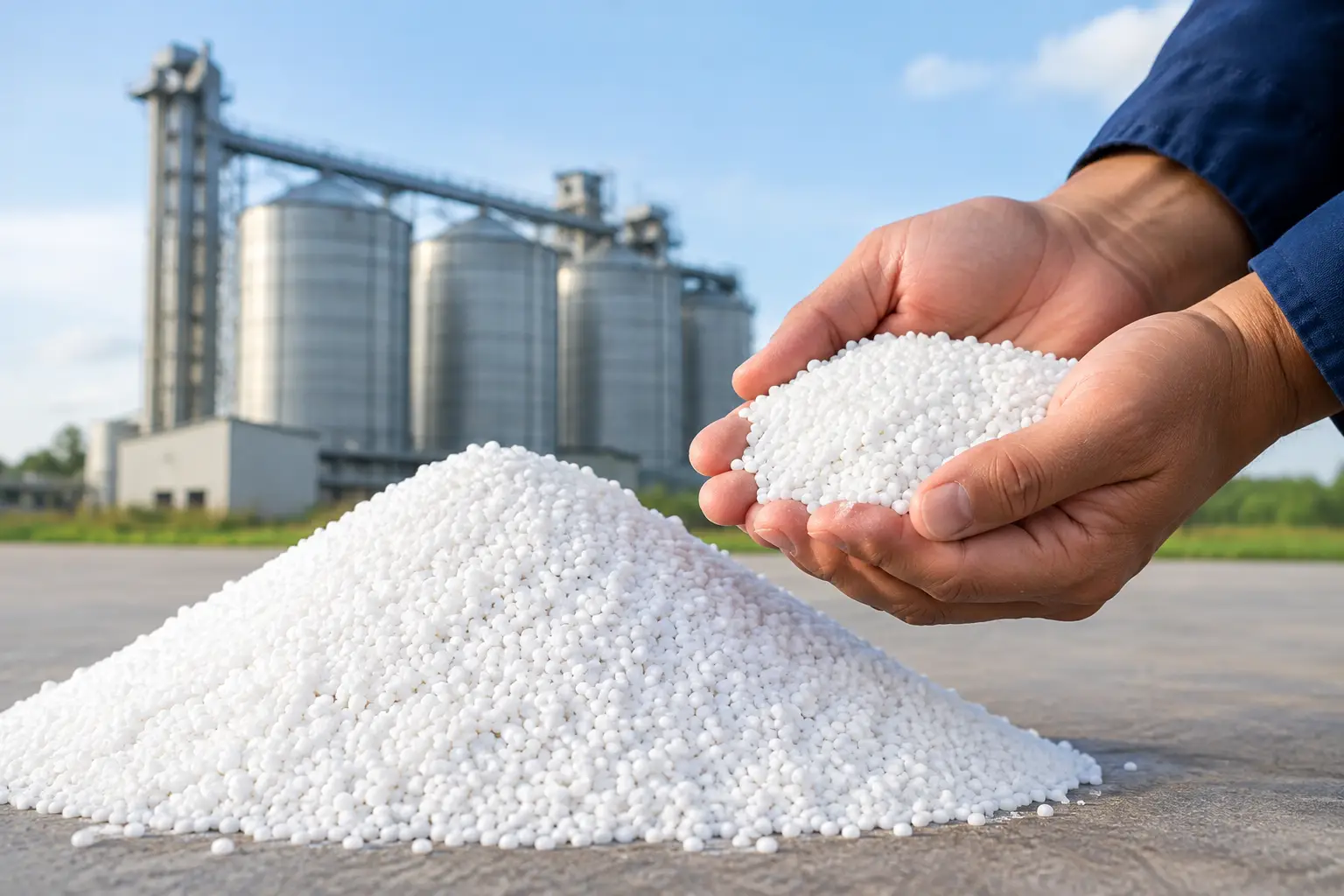

A shipment can meet the headline specification of 46% nitrogen and still be unsuitable for its intended use. The urea certificate of analysis requirements agreed before purchase determine whether a buyer receives evidence for the actual production lot, rather than a generic product statement. For fertiliser distributors, blenders, industrial users and Diesel Exhaust Fluid manufacturers, that distinction protects production schedules, customer commitments and landed-cost decisions.
A Certificate of Analysis, usually shortened to CoA, should confirm measurable properties of the urea supplied. It is not simply a brochure specification and it should not be treated as a substitute for a clear purchase contract. The useful CoA is traceable to a defined lot, issued by the producer or an authorised quality function, and aligned with the grade, packaging and end use ordered.
What a urea CoA needs to confirm
At minimum, a commercial urea CoA should identify the product, production lot or batch number, production date where available, test results, test methods or applicable standards, and the issuer’s approval. These details allow the buyer to connect the paperwork to material loaded into bulk vessels, containers, jumbo bags or 50kg bags.
The core analysis for fertiliser-grade urea generally covers total nitrogen, biuret and moisture. Depending on the agreed specification, it may also state particle-size distribution, free-flowing condition, appearance and insoluble matter. The right set of results depends on how the urea will be handled after arrival.
Granular urea for bulk blending or mechanised field application needs controlled granule sizing. A CoA that states only nitrogen content does not show whether the product is compatible with the buyer’s spreading equipment or blend formulation. Prilled urea may have a different particle profile and is often selected where rapid dissolution is required, including liquid-fertiliser preparation. The certificate should make that grade distinction explicit.
For technical and DEF-grade material, purity controls become more demanding. Low biuret may be essential, while limits on aldehydes, insoluble matter and metal contaminants can be critical to downstream processing. Where urea is intended for Diesel Exhaust Fluid production, the agreed specification should reflect the relevant DEF manufacturing standard and the buyer’s own quality-control procedures. A fertiliser CoA cannot be assumed to demonstrate DEF suitability.
Key urea certificate of analysis requirements by grade
There is no single CoA template that suits every shipment. Procurement teams should agree the required limits before requesting a quote, particularly where the material will enter a controlled production process.
Granular fertiliser urea
For standard granular urea containing 46% nitrogen, the CoA normally needs to report total nitrogen on a mass basis, together with biuret and moisture. Nitrogen confirms nutrient value. Biuret matters because excessive levels can create crop-sensitivity concerns in certain applications, especially where urea is used in foliar or specialist formulations. Moisture affects storage behaviour, caking risk and product flow.
Particle-size data is commercially important for granular supply. Buyers should specify the preferred size range, plus the minimum proportion expected within that range where relevant. This supports consistent bulk blending and reduces the risk of segregation when urea is mixed with other fertiliser components. A description such as “granular” without a stated sizing requirement leaves too much open to interpretation.
Prilled urea
Prilled urea retains the same fundamental nitrogen requirement but is physically different from granular material. Its smaller prills can dissolve quickly, making it suitable for some liquid formulations and applications where a fine, readily soluble product is required.
The CoA should identify the product as prilled urea and include its applicable particle-size result. Buyers should also assess moisture, biuret and appearance alongside the certificate, particularly when the product will be dissolved in tanks or used in controlled formulations. Packaging and storage conditions matter here because moisture uptake can impair free-flowing performance.
Low-biuret technical and DEF-grade urea
Technical buyers require a more detailed quality record. Low-biuret status must be supported by an actual test result, not only a grade name. Depending on the end use, the CoA may need results for alkalinity, aldehydes, insoluble matter, phosphate, sulphate, iron, copper, zinc and other trace contaminants.
The precise parameters and limits should be stated in the purchase specification. This avoids a common procurement error: ordering “technical urea” without defining which contaminants are restricted for the process concerned. For DEF production, buyers should check that testing, handling and packaging arrangements support their required cleanliness controls as well as the chemical analysis itself.
A specification sheet is not a lot-specific CoA
A product specification sheet explains the normal or guaranteed characteristics of a grade. It is useful at the sourcing stage, but it is not evidence that a particular shipment achieved those values. A CoA reports the tested result for a designated lot or production batch.
Both documents have a place in a sound purchasing process. The specification sheet establishes the contract target. The CoA provides pre-shipment or batch-level evidence against it. Where quality risk is high, buyers may also require a retained sample, independent inspection or third-party laboratory testing. That added control comes with cost and timing implications, so it is most appropriate for technical applications, high-value contracts or markets with strict customer documentation requirements.
Match the certificate to the shipment
A CoA has limited value if its batch number cannot be reconciled with the goods received. This is particularly relevant when urea is supplied in several lots, repacked into bags, consolidated at a port or delivered across multiple containers.
Ask the supplier how lot identification will appear on the CoA and on the physical shipment. For bagged material, batch or lot marking on the bag, pallet label or packing list provides a practical traceability route. For bulk cargo, the documentation should identify the production lot, loading period and vessel or container reference as clearly as possible.
It is also sensible to establish when the CoA will be issued. Some buyers need it for document review before cargo release; others require it with the shipping file. If a contract includes an approval stage, allow enough time for the quality team to review the certificate before the material reaches the destination port or warehouse. Late paperwork can delay onward distribution even when the product itself is ready.
Build CoA checks into the purchase order
The most reliable approach is to place the analytical requirements in the purchase order or mutually accepted product specification. Relying on informal correspondence can cause problems when a shipment is scheduled months later or supplied from a different production run.
A practical requirement should state the urea grade, agreed limits, units of measurement, applicable test methods where necessary, lot traceability expectations and the point at which the CoA must be provided. It should also specify whether results are required for each lot, each container, each production campaign or the shipment as a whole.
For routine fertiliser supply, excessive documentation can add administration without materially improving control. For a standard granular order used in broad-acre application, nitrogen, biuret, moisture, particle size and clear lot identification may be sufficient. For technical processing, a broader impurity profile and stricter sampling protocol may be justified. The right level of control depends on the consequence of off-specification material reaching the buyer’s operation.
Questions to settle before confirming supply
Before placing an order, procurement teams should be able to answer the following points:
- Is the urea granular, prilled, low-biuret technical or DEF-grade?
- Which analytical limits are mandatory for the intended use?
- Does the contract require a lot-specific CoA, independent testing or both?
- How will the certificate batch number match bags, containers or bulk-loading records?
- When must the document be issued in relation to loading, payment and delivery?
Clear answers reduce disputes over whether a certificate is complete. They also help suppliers plan sampling, testing and document release without disrupting freight schedules.
AgroUrea Co. can align urea supply documentation with the grade, packaging format and delivery requirement of a commercial order. Provide the intended application, required volume, destination and any mandatory analysis limits at quotation stage. That gives the supply and logistics plan a clear quality basis before the cargo is allocated.