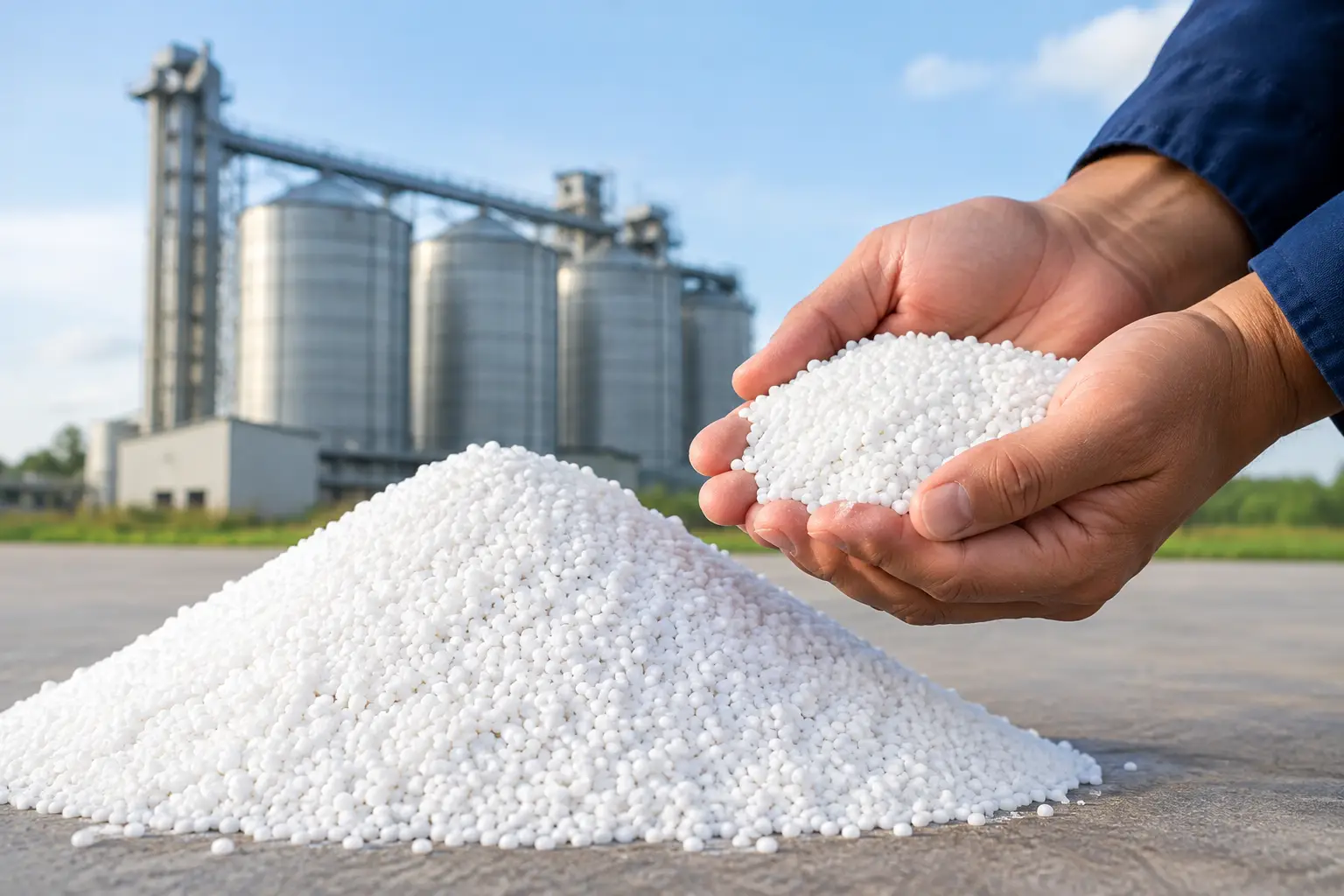

A low biuret urea guide is most useful when it prevents a costly grade-selection error. Urea may be specified as 46% nitrogen across several applications, but identical nitrogen content does not make every product interchangeable. For foliar nutrition, technical processing and Diesel Exhaust Fluid production, biuret level and wider purity controls can determine whether material is suitable, rejected or causes downstream production issues.
Commercial buyers should therefore procure against a defined end-use specification rather than a generic description such as “urea 46%”. The required biuret limit, moisture content, particle form, contaminant profile, packaging and documentation should be agreed before price and freight are compared.
What low-biuret urea means in practice
Biuret is a nitrogen-containing compound formed when urea is exposed to excessive heat during manufacture or handling. It is not an added ingredient. Its presence is naturally linked to the production process, which is why quality control at source matters.
For many soil-applied fertiliser programmes, standard granular urea is appropriate. The fertiliser is incorporated into soil or applied over broad acreage, and the crop is not exposed to a concentrated urea solution directly on the foliage. In these circumstances, the lowest available biuret level may not justify a premium if particle size, free-flowing condition, nitrogen analysis and delivery timing are the more relevant commercial controls.
The position changes for foliar application. High biuret levels can increase the risk of leaf scorch or phytotoxicity, particularly where application rates are high, crops are sensitive or weather conditions limit rapid drying. Buyers supplying soluble foliar formulations should state the maximum permitted biuret content in their purchase enquiry and confirm that the supplied material is intended for that use.
Technical and DEF applications require an even tighter approach. Low biuret alone is not a complete quality standard. A product can have a low biuret result yet still fail the purity requirements needed for a controlled industrial process. The purchasing specification must address the full suite of relevant parameters.
Low biuret urea guide: match the grade to the end use
The first procurement question is simple: what will happen to the urea after delivery? The answer determines the grade, physical form and documentation required.
Foliar and soluble fertiliser formulations
Prilled urea is commonly selected where rapid dissolution is required. Its smaller, more uniform particle form generally dissolves more readily than larger granules, making it practical for liquid-fertiliser manufacture and soluble blends. For foliar use, a controlled low-biuret specification supports safer formulation, but application rate, water quality, crop species and ambient conditions still affect field performance.
A procurement specification should identify the maximum biuret percentage, minimum nitrogen content, moisture limit and expected solubility. If material will be dissolved in tanks, ask for particle-size information and confirm whether any anti-caking treatment could affect the formulation. Do not assume that every prilled product is automatically suitable for foliar use.
Industrial processing
Industrial chemical users may require low-biuret technical urea for resins, adhesives, laboratory reagents or other manufacturing processes. The right specification depends on the process sensitivity. Trace metals, alkalinity, insolubles, moisture and formaldehyde-reactive performance may matter alongside biuret.
Here, technical grade should be treated as a controlled material description, not a marketing label. Provide the intended process and required limits to the supplier. A certificate of analysis should be reviewed against the agreed specification for each lot or shipment, especially where the material feeds an automated or continuous production line.
Diesel Exhaust Fluid manufacture
DEF manufacturers need high-purity urea suitable for producing an aqueous urea solution used in selective catalytic reduction systems. DEF-grade urea is typically assessed against ISO 22241 requirements. Biuret is one controlled parameter, but the standard also addresses substances that could damage vehicle emissions systems or compromise the finished fluid.
This distinction is commercially significant. Buying “low-biuret urea” without confirming DEF-grade compliance can create avoidable exposure. The producer’s documentation should demonstrate conformity with the relevant standard and include the required impurity controls, rather than recording only nitrogen, moisture and biuret.
DEF production also requires disciplined handling. The urea can meet specification when dispatched but become contaminated through unsuitable storage, dirty transfer equipment, poor-quality process water or reused packaging. Procurement and operations teams should assess the complete chain from origin to dissolved product.
Set a purchase specification before requesting a quote
A clear enquiry gives suppliers a fair basis for pricing and makes quotations easier to compare. It also reduces the risk of a technically compliant-looking offer that does not fit the operation.
State the application, expected volume in metric tonnes, destination port or warehouse, required delivery window and preferred packaging. Then define the essential product controls. For low-biuret technical or DEF-grade urea, these will usually include minimum nitrogen content, maximum biuret, maximum moisture, particle size or form, appearance, insoluble matter where relevant, and the required purity standard.
Packaging is an operational decision as well as a purchasing decision. Bulk supply can suit high-throughput blenders and manufacturers with suitable covered storage and handling systems. One-tonne jumbo bags are practical for sites using forklifts and controlled batch consumption. Fifty-kilogram bags may suit distributors or smaller production runs, while selected 25-kilogram bags can be useful where manual handling and unit-level distribution are required.
The lowest ex-works price is not automatically the lowest landed cost. Compare packing costs, port handling, sea freight, inland haulage, unloading capability, warehouse capacity and likely demurrage exposure. A marginally cheaper material can become expensive if its packaging slows production or if delivery timing forces unplanned stockholding.
Verify documents, sampling and lot control
Commercial urea purchasing should be supported by a document set proportionate to the application risk. At minimum, buyers commonly request a certificate of analysis, safety data sheet, commercial invoice, packing list and transport documents. Country-of-origin evidence, independent inspection records or additional conformity statements may also be required under a contract, tender or customer approval process.
The certificate of analysis should identify the lot or production batch and report results against the agreed limits. Check that values are stated in compatible units and that the limits match the purchase order, not merely the supplier’s standard product sheet. A certificate showing biuret at 0.3% is useful only if 0.3% meets the buyer’s actual requirement.
For high-value industrial use, retain a sealed reference sample from each received lot. Incoming sampling should be representative, particularly for bulk cargoes and large bagged consignments. If an independent laboratory test is needed, agree the sampling method, sample retention and dispute procedure before shipment. Post-delivery disagreement is far harder to resolve when neither party can demonstrate how the sample was taken.
Storage and handling controls that protect quality
Urea is hygroscopic. It can absorb moisture from humid air, cake during extended storage and lose its free-flowing condition. It should be kept dry, under cover and away from direct weather exposure. Bags should remain sealed until use and be stored clear of wet floors and walls where condensation can transfer into the product.
For technical and DEF-grade material, cleanliness is equally important. Use dedicated or thoroughly cleaned conveyors, hoppers, augers and dissolution tanks. Avoid contact with fertiliser residues, fuels, oils, metal debris and unverified cleaning chemicals. Segregation is especially important at multi-product sites where standard agricultural urea and higher-purity grades may be handled in parallel.
Temperature management also warrants attention. Avoid unnecessary heat exposure in storage or processing, as excessive temperatures can affect product condition and may contribute to further biuret formation. Stock rotation should follow a first-in, first-out system, with lot identification maintained through warehouse movements.
Questions procurement teams should resolve early
Before placing an order, establish whether the stated low-biuret limit is contractual, whether the product is technically suitable for the intended process, and whether the shipment documentation is sufficient for customer or regulatory requirements. Confirm the required Incoterm, discharge port or final warehouse, bag type, labelling, allowable delivery tolerance and the party responsible for inspection.
It is also worth separating production lead time from transit time. A prompt vessel booking does not guarantee that suitable material is available for immediate loading. Ask when the lot can be released, whether analysis is complete and how long documents will take to issue after shipment. These details protect production schedules more effectively than a broad estimated arrival date.
The right low-biuret urea purchase is not simply the product with the smallest quoted biuret number. It is the grade with a documented specification, appropriate purity profile, workable packaging and a delivery plan that keeps your operation supplied without introducing unnecessary quality risk.