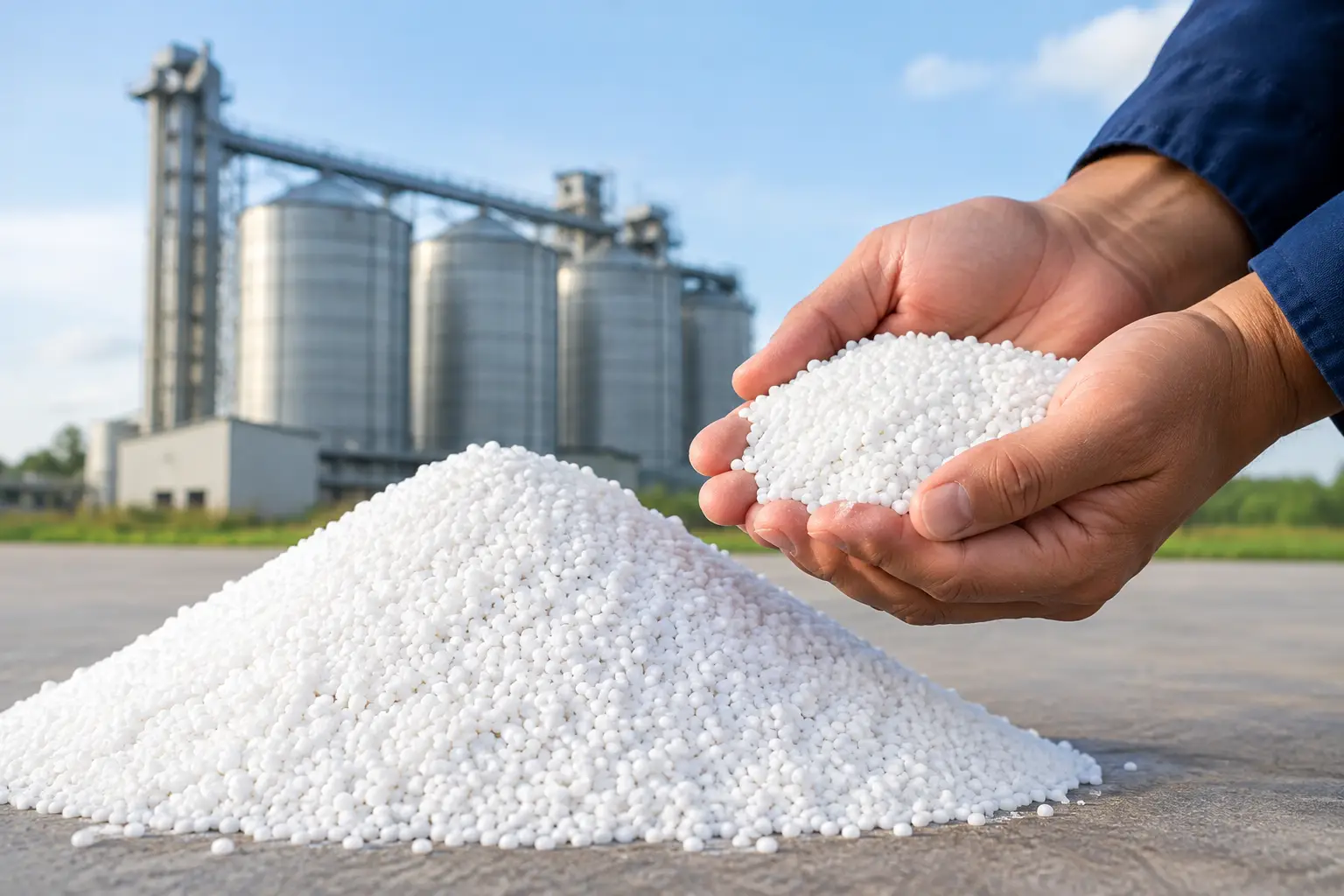

A urea particle size specification is not a minor line on a certificate of analysis. For a distributor, blender, farm operator or industrial buyer, it determines whether product spreads evenly, remains free-flowing through handling equipment, dissolves at the required rate, and arrives fit for its intended use. The correct size range must therefore be agreed alongside nitrogen content, biuret, moisture, packaging and delivery terms.
Urea contains 46% nitrogen when supplied as standard agricultural-grade material, but its physical form varies considerably. Granular urea, prilled urea and low-biuret technical urea are made for different operational requirements. Buying on nitrogen analysis alone can create avoidable issues at the spreading line, in a bulk blend, within a liquid-fertiliser plant or during Diesel Exhaust Fluid production.
What a urea particle size specification should state
A workable specification defines more than a nominal diameter. It should identify the particle-size range, the percentage retained between agreed sieve sizes, the proportion of oversize and fines permitted, and the test method or basis for reporting results. This gives both parties a measurable standard for inspection and acceptance.
Particle size is normally reported in millimetres using a sieve analysis. A result might show the proportion of material within the main agreed fraction, together with the percentage above the upper sieve and below the lower sieve. The main fraction is the commercially useful portion. Oversize particles may bridge screens or affect blend uniformity, while fines create dust, caking risk and inconsistent application.
The suitable range depends on the product grade and application. A buyer should avoid treating a broad market description such as “granular” as a full specification. Granules can differ in diameter distribution, hardness and surface condition even where the product is sold under the same grade name.
Granular urea for spreading and bulk blending
Granular urea is generally selected for mechanised field application and bulk blending because it offers larger, stronger particles than prilled material. A common commercial expectation is a principal size fraction broadly around 2 mm to 4 mm, although the exact sieve limits and percentage within range must be confirmed for each supply lot and contract.
For centrifugal spreaders, consistency matters as much as average particle diameter. Granules of similar size and density travel more predictably from the disc, helping operators achieve a more even bout width. A high proportion of fines can fall short of the intended spread pattern, while excessive oversize may travel further or segregate during transport and handling.
The same principle applies to bulk blending. Urea should be matched as closely as practical with the size profile of companion fertilisers. If one component is materially finer or coarser, segregation can occur in storage, loading, lorry transport and field spreading. The result is a blend that may analyse correctly in a composite sample but apply unevenly across the field.
A granular urea specification for agricultural use should therefore consider particle-size distribution alongside bulk density, crushing strength, moisture and anti-caking condition. No single figure guarantees spreading performance. Equipment settings, blend composition, handling distance, humidity and storage duration all affect the outcome.
Prilled urea for rapid dissolution
Prilled urea is typically smaller and more uniform in appearance than granular product. It is often chosen where rapid dissolution is required, including liquid-fertiliser formulation and selected industrial uses. Its smaller surface area-to-mass relationship means prills generally dissolve faster than larger granules under comparable mixing conditions.
That advantage has a trade-off. Prilled urea can be less suitable for wide-width mechanical spreading and may generate more dust or suffer greater handling damage than high-quality granules. It also needs suitable storage conditions, especially where repeated humidity exposure could promote caking.
The particle size specification for prilled urea should be aligned with the dissolution system, not simply selected as the finest available grade. Very fine material may speed dissolution but increase dust loss and handling difficulty. For a liquid-fertiliser operation, procurement teams should assess screen size, agitation capacity, water temperature, loading method and the acceptable time to achieve a clear, fully dissolved solution.
Technical and DEF-grade urea
For technical applications, including Diesel Exhaust Fluid manufacture, chemical purity is usually the primary qualification point. Low biuret, low aldehyde content, low insolubles and controlled trace contaminants are critical to protecting downstream product quality and process equipment.
Particle size still has a practical role. A consistent, free-flowing prill or granule supports predictable conveying, weighing and dissolution. However, a DEF manufacturer should not substitute an agricultural urea specification for a technical-grade requirement merely because the particle size appears suitable. The purity standard and supporting documentation must take priority.
How particle size affects cost and operations
The cheapest offer per tonne is not always the lowest landed-cost option. Particle-size variation can create costs after delivery: re-screening, dust control, rejected blends, spreader recalibration, slower dissolution or customer complaints. These costs are particularly relevant where product moves through several stages before final use.
For importers and distributors, physical quality should also be considered against the selected pack format. Bulk vessel or container movements demand efficient discharge and protected storage. Product supplied in 1,000 kg jumbo bags requires compatible lifting and discharge arrangements. Fifty-kilogram bags can support more flexible warehouse handling but introduce a greater bag-handling requirement per tonne. In every format, damaged packaging and moisture ingress can increase the proportion of lumps and fines before product reaches the end user.
A defined specification also helps procurement teams compare quotes properly. Two offers may both state 46% nitrogen, yet one may provide a narrow granular fraction with a stated fines limit, while the other supplies a wider, less controlled distribution. They are not equivalent products when destined for bulk blending or precision spreading.
Setting the right specification for the end use
Start with the operational question: what must the urea do after it is delivered? A farm or agricultural contractor using a pneumatic or centrifugal spreader needs a product compatible with its application equipment. A fertiliser blender needs a granule profile that minimises segregation with other inputs. A liquid producer needs dependable dissolution. A DEF producer needs technical compliance first, with particle form selected to suit the production process.
The following points should be confirmed before placing a volume order:
- Product form: granular, prilled, technical-grade or DEF-grade urea.
- Agreed sieve range and minimum percentage within the principal particle fraction.
- Maximum permitted oversize and fines, with the testing basis stated clearly.
- Moisture, biuret and any application-specific purity limits.
- Packaging format, tonnes required, shipment timing and named destination port or warehouse.
This information should be included in the purchase specification and checked against the supplier’s certificate of analysis for the relevant lot. If the material will be blended or processed at scale, retain samples at receipt and use a consistent sampling procedure. A good laboratory result is only meaningful when the sample represents the delivered consignment.
Reading a sieve analysis without ambiguity
Sieve data can be misread when the wording is vague. “2-4 mm” may mean that most material falls within that range, but it does not automatically define how much is allowed below 2 mm or above 4 mm. Buyers should request percentages rather than relying only on a range description.
For example, a contract could require a stated minimum proportion between the selected upper and lower sieves, with separately defined maximum levels for fines and oversize. The actual limits should reflect the equipment and use case. Tight limits may improve consistency but can increase supply cost or reduce availability, particularly during periods of constrained global supply. Wider limits can be commercially sensible where the product is dissolved immediately or used in equipment tolerant of variation.
It is equally useful to distinguish particle size from particle strength. Two granules within the same sieve fraction may perform differently if one is more prone to abrasion. Where multiple transfers, long-distance freight or high-speed blending are expected, discuss crushing strength and dust generation with the supplier rather than assuming size control alone will protect product condition.
Procurement checks before shipment
For regular import programmes, agree the inspection and documentation process before the first shipment. The commercial specification should match the operational requirement, and the certificate of analysis should be issued against the supplied grade and lot. Where contractual quality verification is required, define sampling location, testing responsibility and the treatment of any non-conforming result in advance.
Delivery planning matters as well. Urea is hygroscopic and should be kept dry, protected from contamination and stored on an appropriate surface. Product can remain free-flowing when handled correctly, but even a well-made granular grade can deteriorate if exposed to moisture or repeatedly moved without suitable controls.
AgroUrea Co. can supply granular urea for bulk blending and mechanised application, prilled urea for dissolution-led applications, and low-biuret grades for technical processing. When requesting a quote, state the intended use, required particle-size range, packaging preference, estimated metric tonnes and delivery destination. That gives the supplier the information needed to match physical quality, logistics and commercial terms to the actual operation.
The most useful urea specification is the one that prevents a problem before the shipment is booked: define the sieve profile, verify the accompanying quality data, and buy the grade that suits the equipment waiting at the other end.