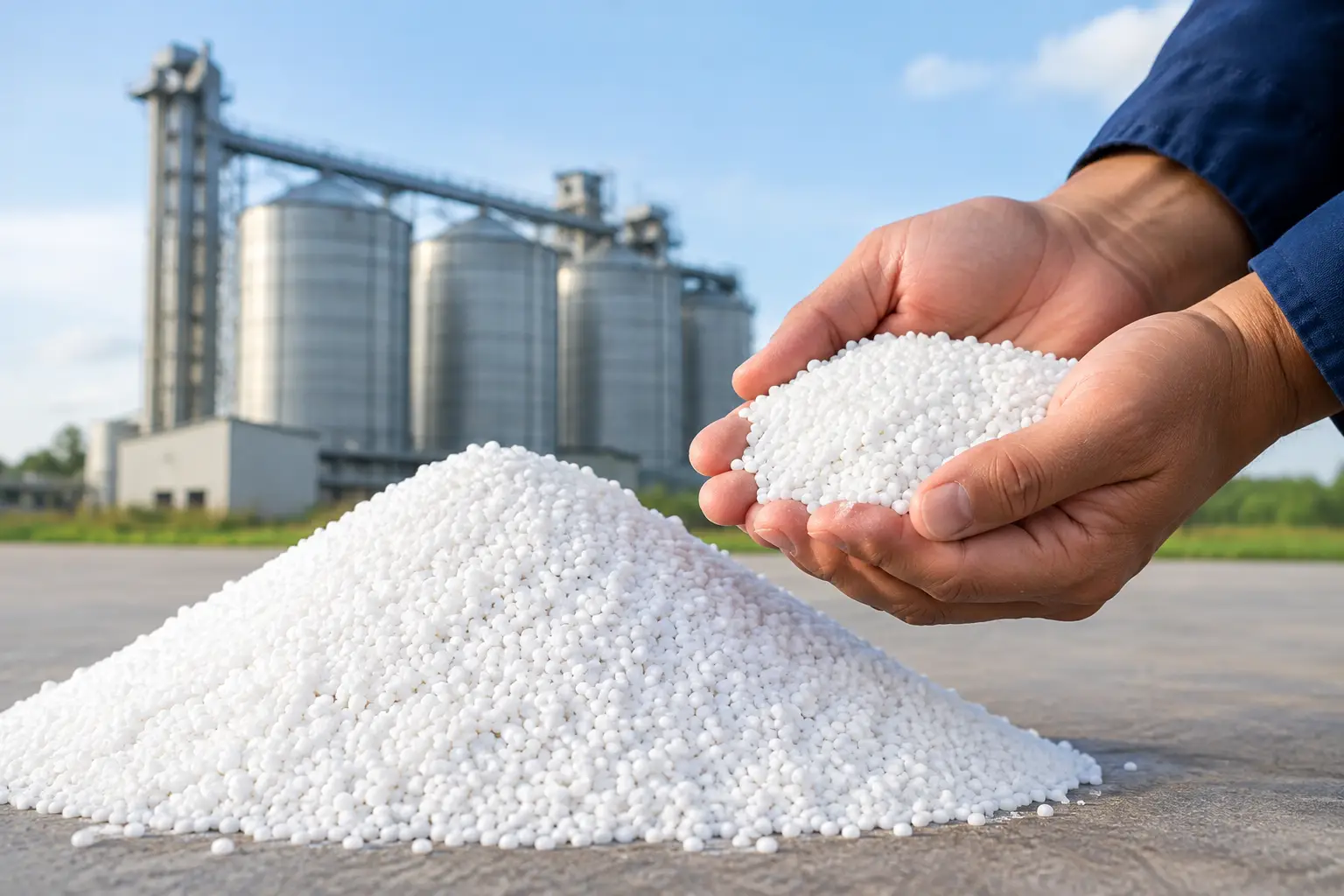
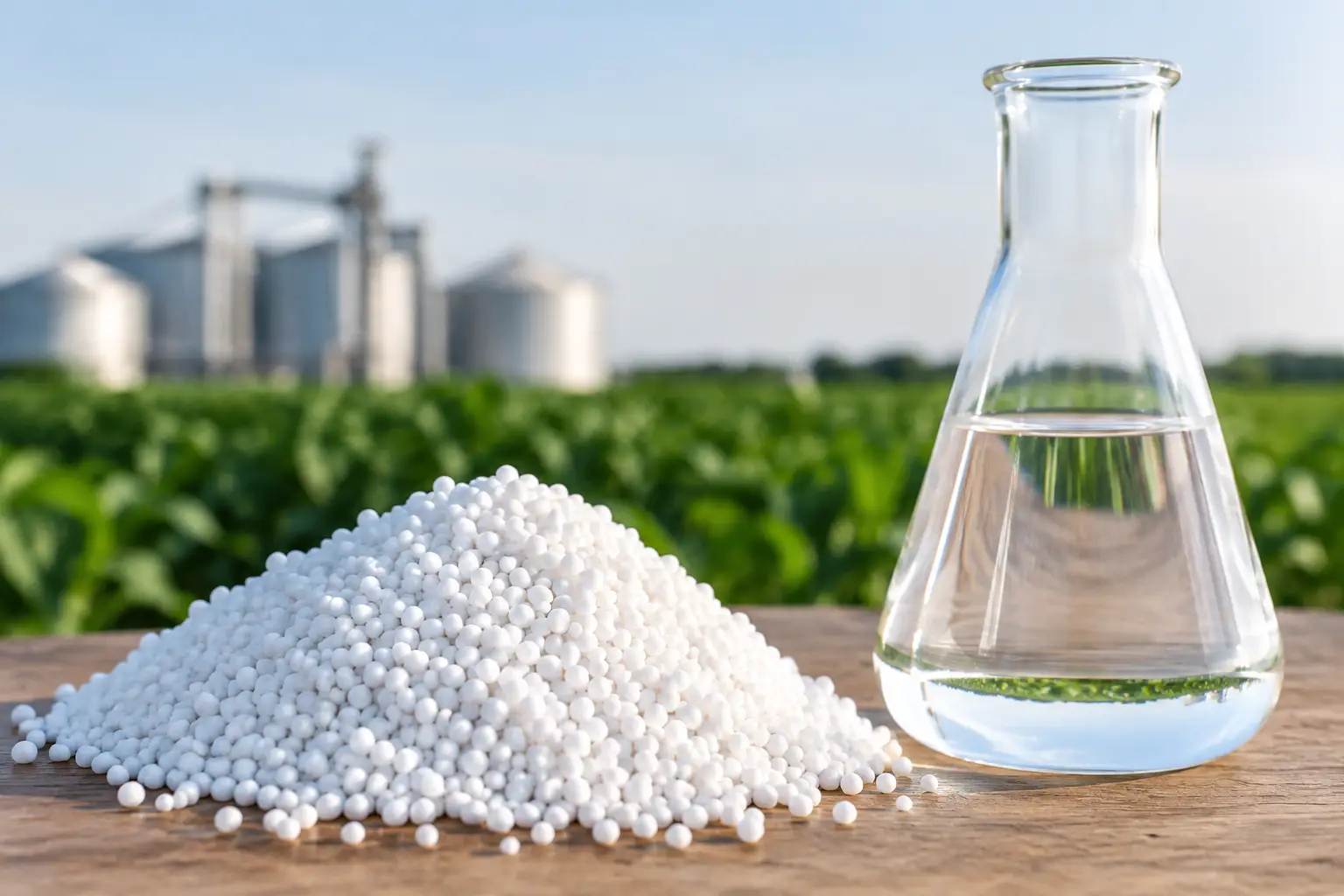
Liquid fertiliser production depends on more than securing a nitrogen source at a competitive price. The material must dissolve predictably, fit the intended formulation and arrive in a condition that keeps processing on schedule. Prilled urea for liquid fertiliser is widely specified where rapid dissolution, high nitrogen content and consistent handling are required for commercial formulation operations.
For importers, blenders and large-scale agricultural businesses, the buying decision should begin with the finished product requirement. A prill suitable for dissolving into a liquid fertiliser programme is not assessed in the same way as granular urea intended for direct field application or bulk blending. Particle size, moisture, biuret, packaging and delivery planning all affect the practical cost of producing and distributing liquid nitrogen products.
Why prilled urea suits liquid formulations
Urea contains 46% nitrogen, making it one of the most concentrated solid nitrogen fertilisers available. This high nutrient concentration reduces the mass of product required to deliver a specified nitrogen analysis, which can support efficient freight, storage and formulation economics.
Prilled urea is manufactured as smaller, generally more uniform particles than standard agricultural granular urea. The increased surface area supports faster wetting and dissolution when handled correctly. For liquid fertiliser manufacturers, this can reduce mixing time and help maintain a more consistent production cycle, particularly where batches are prepared frequently or tank capacity is limited.
The benefit is operational rather than automatic. Dissolution speed still depends on water temperature, agitation strength, order of addition, concentration targets and the quality of the incoming water. Cold water and highly concentrated solutions will extend dissolving time. A supplier should therefore provide a clear product specification, while the buyer confirms performance under its own plant conditions.
Selecting prilled urea for liquid fertiliser production
The first question is whether the urea will be used in a soil-applied liquid, a foliar feed, a blended liquid nutrient product or a technical process. Each application places different demands on the material and on the finished solution.
Particle size and free-flowing condition
A controlled prill size is central to predictable dissolution. Fine or heavily degraded material can create dust during unloading and transfer. Oversize particles may dissolve more slowly than planned. Buyers should request the applicable particle-size range and confirm that it suits the intake, conveying and mixing equipment at the destination.
Free-flowing condition matters equally. Urea can absorb moisture, and poor storage or inadequate packaging can lead to caking. Caked product slows discharge, makes accurate batching more difficult and may require additional labour before the material reaches the dissolving tank. The product should be protected from moisture throughout port handling, warehouse storage and onward transport.
Biuret level and application suitability
Biuret is a normal by-product of urea manufacture. Its significance depends on end use. For many soil-applied liquid fertiliser formulations, standard agricultural-grade urea may be suitable provided the specification meets the buyer’s requirements. Where the final product is intended for foliar use or a sensitive technical application, lower-biuret material may be required.
Foliar programmes require particular care. Crop sensitivity, dilution rate, spray timing, water quality and local agronomic advice all influence the acceptable formulation. Low-biuret urea can reduce a formulation risk, but it does not replace proper testing or sound application practice. Procurement teams should avoid treating all prilled urea as interchangeable when the finished product has a defined biuret limit.
Moisture and insolubles
Moisture content influences handling, storage stability and the effective nutrient concentration of the product. A controlled moisture specification supports free-flowing performance and helps the formulator calculate inputs accurately. Insoluble matter should also be considered, especially where filters, nozzles or narrow pipework form part of the production and application system.
Ask for the certificate of analysis or agreed specification before shipment. The key point is not simply receiving a urea product labelled as 46% nitrogen, but receiving material with parameters aligned to the intended liquid fertiliser process.
Formulation and dissolution controls
A consistent liquid product starts with a controlled process. Urea should normally be added steadily to adequately agitated water rather than tipped into a stagnant tank. This helps prevent local over-concentration and reduces the risk of undissolved material settling at the base of the vessel.
Water temperature has a direct effect on solubility and production speed. Warmer water generally allows quicker dissolution and higher practical concentrations, while cold conditions can slow the process substantially. Operations planning winter production should allow extra residence time, sufficient agitation and realistic tank throughput rather than assuming summer mixing performance.
The final concentration must remain appropriate for expected storage and transport temperatures. A solution that appears clear at the time of manufacture may crystallise later if its concentration exceeds what conditions permit. This is a commercial issue as well as a technical one: crystallisation can block pumps, interrupt deliveries and result in costly reprocessing.
Compatibility testing is advisable when urea is combined with other nutrients, micronutrients, stabilisers or crop-protection inputs. The presence of another ingredient can alter pH, solubility and storage behaviour. Bench-scale trials and retained samples provide more certainty than relying on a theoretical blend calculation alone.
Packaging and logistics for commercial buyers
The best packaging format depends on annual volume, site equipment and the route to the final processing location. Bulk supply can be appropriate for high-throughput operations with suitable reception and storage facilities. It can reduce packaging handling and support efficient intake where shipment volumes justify it.
For importers, distributors and sites without bulk infrastructure, 1,000kg jumbo bags offer a practical balance between volume and warehouse handling. They can be moved by forklift and released into a hopper or feed system in a controlled manner. Fifty-kilogram bags may suit smaller production runs, regional distribution or sites where manual handling systems are already established. Selected 25kg formats may be relevant where handling constraints or downstream customer requirements justify the additional packaging component.
Packaging should be chosen with the full supply chain in mind. Consider port discharge arrangements, warehouse space, forklift capacity, weather protection, bag disposal and the speed at which stock will be consumed. Urea should be stored in a dry, covered area away from sources of moisture and contamination. Stock rotation remains sensible practice, particularly where product is held through humid periods.
Procurement checks before placing an order
A useful enquiry gives the supplier enough detail to quote accurately and match the product to the application. State the estimated volume in metric tonnes, preferred packaging, required delivery point and expected delivery window. For international movements, name the destination port or warehouse and establish which party is responsible for onward haulage, customs requirements and unloading arrangements.
The specification should identify nitrogen content, biuret limit where relevant, moisture target, particle-size range and any documentation required by the receiving operation. Buyers using the material in regulated or customer-facing formulations may also need batch traceability, certificates of analysis and inspection requirements agreed before loading.
Landed cost should be assessed rather than comparing only the ex-works or port price. Ocean freight, insurance, port charges, bagging format, inland lorry transport, handling losses and working capital can materially change the true cost per tonne of available nitrogen. A slightly lower unit price is not a saving if the shipment format creates delays, excessive handling or avoidable quality risk.
Supply timing is equally significant. Liquid fertiliser demand often rises ahead of planting and application windows, when warehouse space and transport capacity can tighten. Ordering against a realistic production forecast gives more scope to coordinate shipment, protect continuity of supply and avoid last-minute substitutions.
Matching the grade to the job
Prilled urea offers a practical route to high-nitrogen liquid fertiliser production where rapid dissolution is a priority. It is not automatically the right choice for every operation. Granular urea may be better suited to direct spreading and bulk blending, while low-biuret technical grades may be necessary where formulation specifications are more demanding. The correct choice depends on the end use, plant capability and the quality parameters the finished product must meet.
AgroUrea Co. supplies 46% nitrogen urea in prilled, granular and low-biuret grades, with bulk and bagged formats aligned to commercial handling requirements. A detailed specification and clear delivery plan give procurement teams the information needed to secure material that performs as expected from discharge through to formulation.
Before committing volume, confirm the grade, biuret requirement, packaging format and destination handling plan against the actual production process. That disciplined check is often what keeps a competitively priced urea shipment from becoming an avoidable formulation delay.