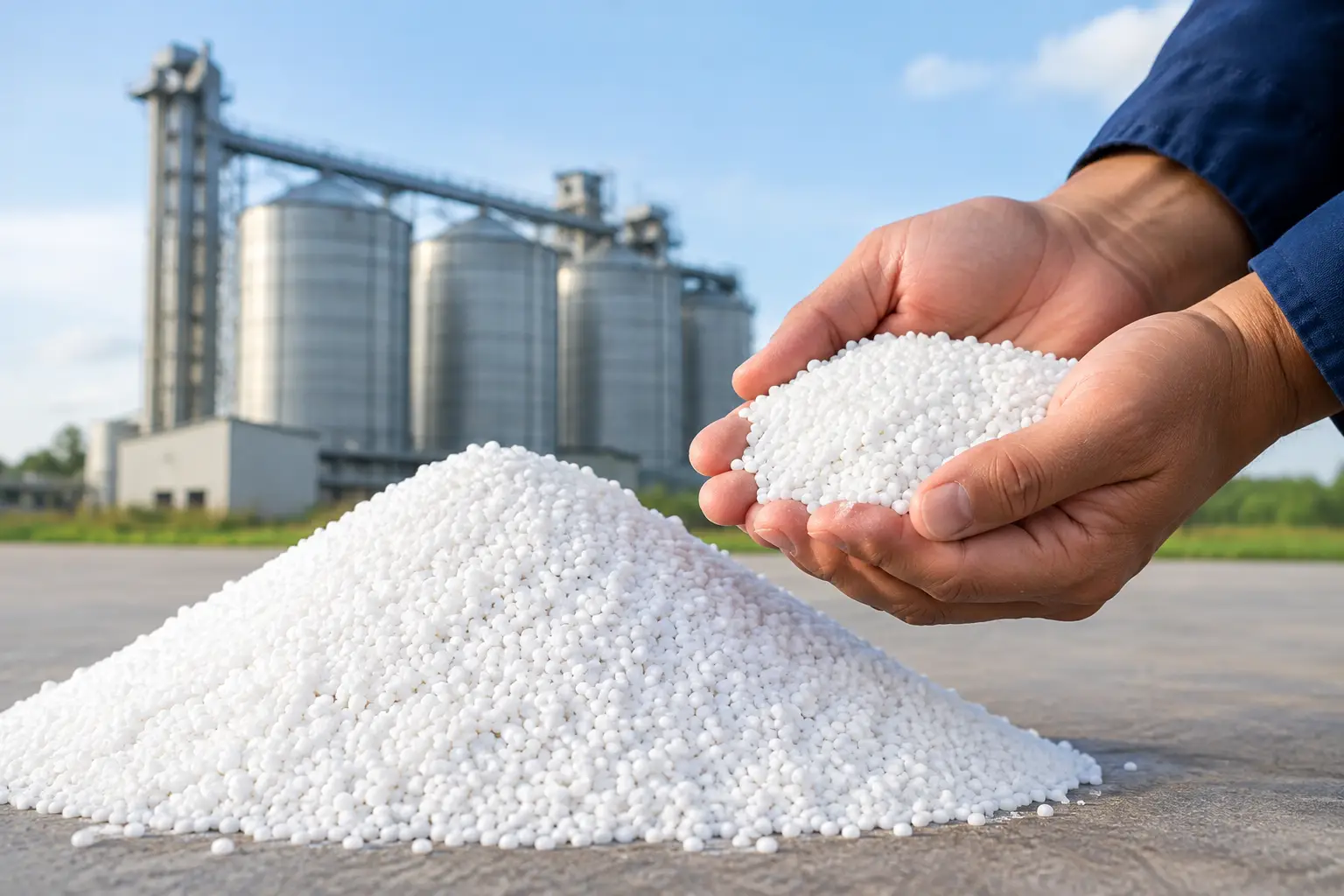

A low biuret figure is not simply a quality preference when buying low-biuret urea for industrial processing. It can determine whether a production run meets its specification, whether a solution remains stable and whether an end product is accepted by a customer or regulator. For procurement teams, the practical task is to buy a grade that matches the application exactly, with test data, packaging and delivery terms that support uninterrupted operation.
Low-biuret technical urea is commonly specified for Diesel Exhaust Fluid production, chemical manufacture and processes where predictable purity matters more than the nutrient value associated with agricultural urea. Although urea contains approximately 46% nitrogen, industrial suitability depends on considerably more than nitrogen content.
Why biuret control changes the purchasing decision
Biuret forms when urea is exposed to heat during manufacture or handling. It is a natural by-product of the urea production process, but its concentration must be controlled for applications that demand high-purity material. A product described as low-biuret urea generally has a lower biuret level than standard fertiliser-grade urea. The required limit, however, depends on the intended use.
For Diesel Exhaust Fluid, urea must satisfy the applicable ISO 22241 requirements. Biuret is only one of several controlled properties. A supplier statement that material is “low-biuret” is therefore not, on its own, evidence that it is suitable for DEF manufacture. Buyers should request a current certificate of analysis and confirm the full technical specification, including biuret, aldehydes, insoluble matter, phosphate, metals and moisture where relevant.
Other industrial processes may have different tolerances. In some chemical applications, a low biuret result is sufficient provided the urea dissolves consistently and does not introduce unacceptable contaminants. In others, such as high-purity aqueous formulations, the specification may be tighter than a standard technical grade. The correct question is not whether the material is high quality in general terms, but whether every controlled parameter fits the process and finished-product requirement.
Low-biuret versus agricultural urea
Agricultural urea is primarily selected for nitrogen content, physical form and suitability for spreading, bulk blending or dissolution in fertiliser programmes. Granular and prilled products may be appropriate for those uses, yet they are not automatically interchangeable with technical urea.
Technical and DEF-grade urea is purchased against a more exacting purity profile. It is typically free-flowing, carefully screened and supported by batch documentation. Using a lower-cost agricultural grade in an industrial system can create false economy if extra filtration, failed laboratory results, equipment fouling or rejected finished product follow. Conversely, buying DEF-grade material for an application with less demanding purity requirements may add cost without creating operational benefit. Specification should lead the decision.
Specifying low-biuret urea for industrial processing
A purchase enquiry should translate production requirements into measurable acceptance criteria. Start with the maximum permitted biuret content. Then identify the properties that affect dissolution, storage, handling and final-product compliance.
Nitrogen content remains a useful confirmation of urea concentration. High-quality urea is commonly supplied at 46% nitrogen, but buyers should define any minimum accepted value in the contract specification. Moisture is equally important because excessive moisture can affect free-flowing behaviour, encourage caking and alter material handling performance. It may also change the effective concentration when urea is dissolved into a controlled formulation.
Particle-size distribution deserves attention where urea is transferred pneumatically, fed through dosing equipment or dissolved at a defined rate. Prilled urea often dissolves rapidly because of its smaller particle form, while other technical grades may be supplied in forms selected for handling or process needs. There is no universally best particle size. The right choice depends on hopper design, conveying method, dissolving tank capacity, agitation and required batch time.
For DEF manufacturers, purity requirements extend beyond the primary urea assay. Trace metals and insolubles can affect equipment protection systems and the quality of the finished fluid. Procurement teams should align incoming material limits with their own blending, filtration and quality-control procedures rather than relying only on a generic grade name.
Documentation that should accompany the shipment
Commercially usable technical urea requires clear evidence of conformity. A certificate of analysis should identify the production batch and report the agreed test parameters against the relevant limits. The document should be reviewed before use, not filed after the material has entered production.
Depending on the destination and application, buyers may also require a safety data sheet, certificate of origin, packing list, bill of lading or other shipping documents. Where material is sold for DEF production, the paperwork should support the manufacturer’s compliance records and batch traceability. Confirm document requirements before loading, particularly for imports moving through a named port, bonded warehouse or third-party logistics site.
It is sensible to agree how non-conforming material will be handled before the first order is placed. Define sampling arrangements, analytical method, claim timescale and the party responsible for inspection costs. This is especially relevant for containerised cargo, where a delay in recognising a problem may add storage, demurrage or production costs.
Packaging and logistics affect product condition
The best laboratory result has limited value if the material arrives caked, contaminated or inaccessible to the plant. Urea is hygroscopic, so packaging and storage protection are part of the quality plan. For high-volume users, bulk supply may offer the most efficient landed cost where receiving equipment and dry storage are available. It also reduces bag handling and packaging waste.
For importers, distributors and plants without bulk-receiving capability, 1,000kg jumbo bags provide a practical balance between shipment efficiency and controlled handling. They suit forklift operations and allow staged consumption. Standard 50kg bags may be appropriate for smaller production sites, trials or customers with manual handling arrangements, while selected 25kg bags can support specialist distribution channels.
Packaging choice should be made alongside a realistic review of storage conditions. Bags should remain dry, protected from direct weather exposure and stored to prevent damage during stacking. Warehouses must be able to turn stock on a first-in, first-out basis, particularly where production schedules are variable. A technically compliant product can still become difficult to process after poor storage.
Freight planning also needs to consider the receiving point. A competitive ex-works price does not necessarily produce the lowest landed cost once container loading, port charges, clearance, inland haulage and unloading are considered. Buyers should provide the required volume in metric tonnes, preferred packaging, delivery destination and target delivery window when requesting a quotation. This allows freight to be assessed against the actual supply route rather than assumed conditions.
Quality control from arrival to dissolution
Receiving inspection provides a useful second line of control. Check bag condition, lot identification, visible moisture exposure and the certificate of analysis against the purchase specification before releasing stock. Where the application is tightly controlled, retain representative samples from each batch for traceability and independent testing if required.
During dissolution, water quality can be as significant as urea quality. DEF producers, for example, need demineralised water and controlled manufacturing conditions to produce compliant fluid. Adding high-purity urea to unsuitable water will not produce a compliant result. The same principle applies to other industrial solutions: assess the whole formulation system, including tanks, filters, transfer lines and cleaning procedures.
Temperature management is another operational consideration. Urea dissolves more readily under suitable mixing and temperature conditions, but excessive heat can contribute to degradation and undesired by-product formation. Follow the process specification, monitor concentration and avoid treating dissolution as a purely mechanical step.
Building a dependable supply arrangement
Industrial urea purchasing works best when technical and commercial teams agree the specification before price negotiations begin. Procurement can then compare like-for-like quotations rather than weighing an apparently lower price against an undefined grade. Confirm the biuret limit, moisture range, physical form, contaminants, documents, packaging, shipment quantity and delivery basis in writing.
Supply continuity should also be assessed. A single container may satisfy an immediate requirement, but regular users need a realistic view of lead times, production allocation, port routing and warehouse capacity. Ordering too late can expose a plant to expensive spot purchases or idle production. Holding an appropriate safety stock can be justified where the cost of interruption exceeds the carrying cost of inventory.
AgroUrea Co. supplies technical and DEF-grade urea for buyers that need clear specifications, practical bagging options and coordinated international freight. A precise enquiry makes quoting faster and reduces the risk of receiving material that is commercially available but technically unsuitable.
The most useful next step is to review the process specification with the people who run the plant, then request a quote based on the actual grade, tonnes, packaging and delivery destination required. That level of clarity protects both the production schedule and the landed-cost calculation.