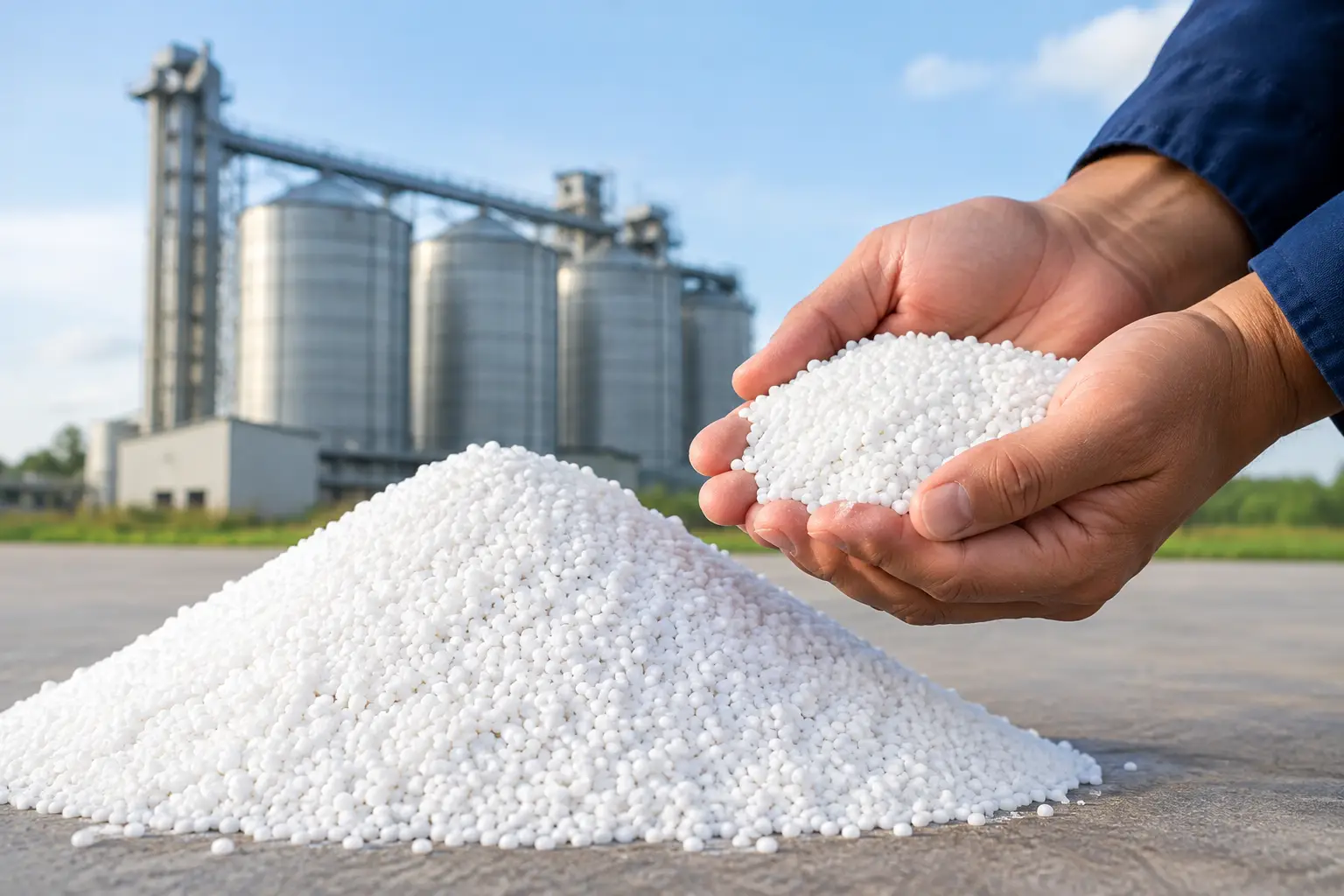

A biuret figure can look like a minor line on a certificate of analysis. For a fertiliser blender, DEF manufacturer or distributor supplying sensitive crop programmes, it can determine whether a urea consignment is fit for purpose. The acceptable biuret level in urea depends on how the material will be used, not simply on its 46% nitrogen content.
Urea is a highly efficient nitrogen source, but not every urea grade suits every application. Standard agricultural material may perform well when incorporated into soil or spread across broad-acre crops. Foliar formulations, greenhouse programmes and Diesel Exhaust Fluid production require tighter control. Procurement specifications should therefore state the maximum biuret content before price, packaging and delivery terms are agreed.
What biuret is and why it occurs in urea
Biuret is an impurity formed when urea is exposed to heat during manufacture. At elevated temperatures, urea molecules can combine and release ammonia, creating biuret. Modern production plants control this reaction, but the final concentration varies with process conditions, melt handling and product grade.
The issue is not that biuret reduces the headline nitrogen analysis substantially. Urea containing 46% nitrogen can still have a biuret level that is unsuitable for a particular use. The concern is phytotoxicity in sensitive plants and strict contaminant limits in technical applications.
For conventional soil-applied fertiliser, moderate biuret is usually diluted in the soil and presents limited risk when product is used correctly. When applied directly to leaves or used in a regulated fluid such as Diesel Exhaust Fluid, the tolerance is much lower. This is why a buyer should not treat all granular, prilled and technical urea as interchangeable commodities.
Acceptable biuret level in urea by application
There is no single maximum that applies to every urea purchase. A practical buying specification should reflect the crop, application method, formulation and relevant technical standard.
| Intended use | Typical maximum biuret specification | Procurement position | |—|—:|—| | Standard soil-applied agricultural urea | Up to 1.0% | Common benchmark for general field use and bulk blending | | Foliar fertiliser and sensitive crop programmes | 0.3% or lower | Use low-biuret urea and validate compatibility with the formulation | | Diesel Exhaust Fluid and technical processing | 0.3% maximum | Required for DEF-grade material meeting ISO 22241 requirements |
For broad-acre agriculture, a maximum of 1.0% biuret is widely used as a commercial specification for standard urea. Some supply contracts may permit up to 1.5%, particularly where material is intended solely for soil application. However, specifying 1.0% gives buyers greater consistency and reduces the chance that stock is unsuitable for a later blending or specialty-fertiliser requirement.
For foliar use, low-biuret urea at 0.3% or below is the safer commercial standard. Leaf tissue receives the product directly, with no soil buffer. Repeated applications, high solution strength, warm conditions and water stress can all increase the risk of crop damage, even where the urea itself meets a low-biuret specification. The biuret limit is therefore one part of a properly controlled foliar programme, alongside dilution rate, water quality and application timing.
For Diesel Exhaust Fluid, the requirement is more definitive. DEF-grade urea must meet ISO 22241 quality limits, including a maximum biuret content of 0.3% by mass. A product described merely as agricultural urea should not be assumed suitable for DEF manufacture. DEF production also requires control of aldehydes, insoluble matter, phosphate, metals and other contaminants that could affect selective catalytic reduction systems.
Why a higher biuret level can create costly problems
Biuret can cause visible crop injury where exposure is direct or repeated. Typical symptoms include leaf-tip burn, chlorosis and reduced growth. Sensitivity differs between crops, growth stages and growing conditions, so a level that is acceptable for a cereal crop applied to soil may not be appropriate for citrus, protected horticulture or a high-frequency foliar feed programme.
The operational risk is broader than agronomy. A distributor may receive standard urea that meets a general fertiliser specification, then find it cannot be allocated to a customer requiring low-biuret material. A blender may face reformulation delays. A DEF producer may reject the shipment altogether if the supporting documentation does not demonstrate technical compliance.
Price comparisons should account for this distinction. Low-biuret and DEF-grade urea can command a premium because of production control, quality assurance and traceable documentation. That premium is often justified when it avoids rejected batches, production downtime or an unsuitable finished fertiliser.
Selecting the right urea specification
Start with the final use rather than the product appearance. Granular urea is usually selected for bulk blending, mechanical spreading and large-scale agricultural application. Prilled urea is often preferred where rapid dissolution is needed for liquid fertiliser manufacture. Low-biuret technical urea is specified where purity and contaminant control are central to the process.
A clear purchase enquiry should state whether the material is for soil application, foliar formulation, industrial processing or Diesel Exhaust Fluid. It should then set a maximum biuret figure rather than simply requesting “high-quality urea”. This removes ambiguity between buyer, supplier, inspection party and receiving operation.
For standard agricultural urea, a specification such as “46% nitrogen, biuret maximum 1.0%, moisture maximum as agreed, free-flowing granular product” gives a workable starting point. For low-biuret applications, state “biuret maximum 0.3%” and identify the intended formulation. For DEF, request urea that conforms to ISO 22241 and require the associated quality documentation for the supplied lot.
Packaging also matters. Bulk vessel, bulk lorry, 1,000 kg jumbo bags and 50 kg bags may all be suitable for agricultural urea, depending on handling equipment and storage capacity. Technical material should be protected from contamination throughout bagging, transport and warehouse handling. A compliant factory analysis cannot compensate for poor segregation at the destination.
How to verify biuret before shipment and receipt
The certificate of analysis should show the actual biuret result for the production lot, not only a statement that the material is “within specification”. Check that the lot number, production date, product grade and quantity correspond with the shipping documents. Where the destination use is sensitive or regulated, agree the sampling and independent inspection procedure in advance.
Biuret should be assessed alongside nitrogen, moisture, particle size and appearance for agricultural purchases. High moisture can increase caking risk during storage, while an unsuitable particle-size range can affect spreading pattern or blending uniformity. A consignment may meet the biuret requirement but still create handling losses if the wider specification is incomplete.
For DEF-grade urea, purchasers should review the full technical certificate, not biuret alone. The relevant ISO limits apply to multiple impurities. Traceability, clean packaging and controlled transport are part of product suitability because the final DEF solution must protect vehicle emissions equipment.
Where stock may be allocated across multiple markets, it is commercially sensible to segregate standard and low-biuret grades at the point of receipt. Mark warehouse locations and inventory records clearly. This prevents a lower-specification agricultural lot from entering a foliar or technical production stream by mistake.
Put the biuret limit in the purchase contract
The most effective control is a concise, measurable specification on the purchase order or sales contract. It should identify the grade, minimum nitrogen content, maximum biuret content, moisture limit where relevant, packaging format, inspection basis and named delivery point. If the product is required for DEF, the contract should expressly require ISO 22241 conformity rather than relying on a generic description such as “technical urea”.
Buyers should also clarify whether the stated maximum applies at loading, discharge or final delivery. This is particularly useful for international shipments where sampling may occur at more than one stage. Agreement on test method, sample retention and claims procedure gives both parties a clear basis for resolving any quality question.
AgroUrea Co. can supply granular, prilled and low-biuret urea in bulk and bagged formats, allowing commercial buyers to align product grade with application, handling method and destination requirements. The right biuret limit is not an extra detail to add after a quote is received. It is the specification that ensures the urea arrives ready for the job it was bought to perform.