
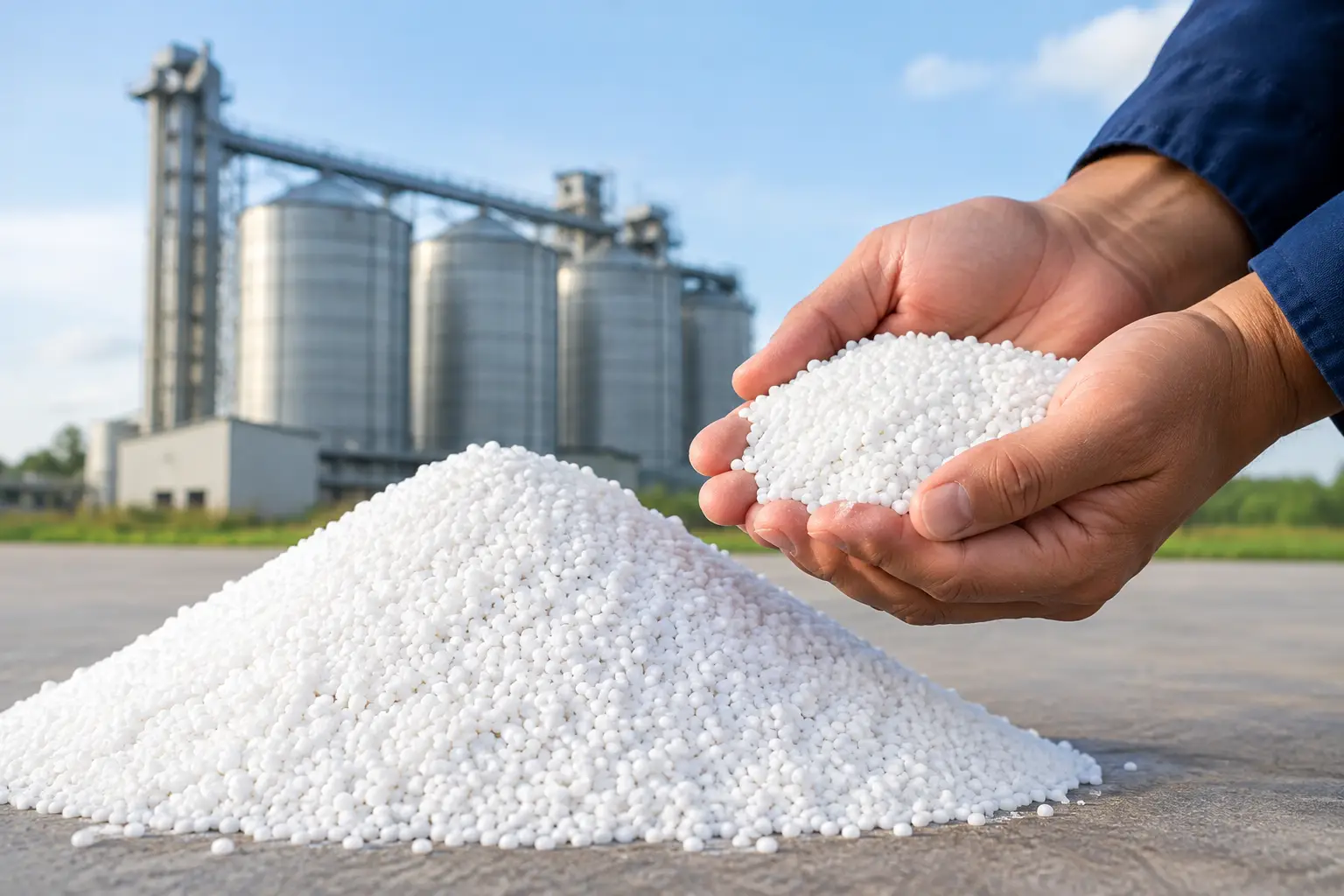
Granular urea for bulk blending is not simply a nitrogen purchase. For a blender, importer or large farming operation, the material must move predictably through receiving, storage, conveying and application while contributing a consistent 46% nitrogen to the finished blend. A low headline price has limited value if variable granule size, excess moisture, poor packaging or delayed arrival disrupts the production schedule.
The right procurement decision starts with the intended route to market. Granular urea is generally selected where physical blending, bulk handling and mechanised field application are required. It is designed to remain free-flowing, tolerate normal handling and blend more evenly with compatible granular fertiliser components than prilled material. The exact specification, packing format and shipment plan should be agreed before a purchase order is placed.
Why granular urea suits bulk blending
Granular urea contains 46% nitrogen, making it one of the most concentrated solid nitrogen fertilisers available for dry blending. This enables blenders to build NPK, NP or nitrogen-sulphur grades without carrying unnecessary volume through the plant. Fewer tonnes may be needed to achieve the required nutrient analysis than with lower-analysis nitrogen sources, which can improve storage efficiency and freight economics.
Its physical form matters as much as its analysis. Granules are manufactured for handling through bulk fertiliser systems, including hoppers, belts, lifts and blending equipment. A suitable particle-size range helps reduce segregation when urea is combined with other granular materials. Better physical compatibility supports a more uniform nutrient distribution in the final product and reduces the likelihood of complaints from farm customers.
This does not mean every granular urea specification will perform identically in every blend. The best match depends on the particle size and density of the other components, the type of blender in use, the handling distance, local humidity and whether the finished blend is bagged or loaded directly for farm delivery. Procurement teams should assess the material against the real production route rather than buy solely on nitrogen content.
Key specifications for granular urea for bulk blending
A commercial specification should clearly state nitrogen content, biuret level, moisture content and granule size. These figures give buyers a practical basis for comparing offers and confirming that a product is appropriate for agricultural use.
Nitrogen content should be stated as 46%, subject to the agreed contractual tolerance and applicable standards. This is the core value driver of urea, and it affects blend calculations, nutrient labelling and the number of tonnes required for the season. Receiving checks should confirm that the delivered product aligns with the certificate of analysis and purchase specification.
Biuret is another relevant control point. Excessive biuret can create crop-safety concerns in sensitive applications, particularly where urea is used in foliar programmes or specialised formulations. For conventional dry bulk blending and soil application, standard fertiliser-grade levels are usually suitable. Buyers needing low-biuret urea for technical processing, liquid fertiliser manufacture or Diesel Exhaust Fluid should specify that requirement separately, as it is a different grade decision.
Moisture needs close attention because it affects flowability and storage behaviour. Urea is hygroscopic, meaning it can absorb moisture from the air. Material stored in humid conditions or exposed to condensation can cake, bridge in hoppers and become harder to meter accurately. A controlled moisture specification, dry loading conditions and protected storage are therefore commercially significant, not merely laboratory details.
Particle-size information should be requested in a usable form, ideally with the declared granule range and the expected proportion of fines or oversized material. Buyers blending with ammonium sulphate, muriate of potash, DAP or other granular inputs should compare the physical profiles before committing to volume. A blend may be chemically correct yet still segregate during transport if the component sizes differ too widely.
Match packaging to handling and order volume
Packaging should support the receiving site, not complicate it. Bulk cargo can be efficient for customers with suitable port, warehouse and bulk-handling infrastructure. It is commonly selected for high-volume import programmes and continuous blending operations where the product can be discharged, transferred and stored under cover without unnecessary rehandling.
For buyers requiring flexibility at destination, 1,000 kg jumbo bags provide a practical balance between volume efficiency and controlled warehouse movement. They can suit regional distributors, blending facilities with intermittent demand and farm supply operations that need to manage stock in defined units. Standard 50 kg bags remain useful where manual handling, onward distribution or smaller releases are required, while selected 25 kg bags may be appropriate for specific channels.
The choice is not only about purchase price per tonne. Bagged supply can increase packaging and handling costs, but it may reduce losses, improve stock control and avoid the capital requirement for bulk reception. Bulk supply can offer stronger economics at scale, but only if discharge, storage and internal transfer are properly organised. The most competitive option is the one that delivers the required tonnes in usable condition at the point of blending.
Protect product condition from port to plant
Urea can be damaged operationally by poor handling even when it leaves the producer within specification. Procurement teams should plan the complete route: loading, ocean freight where relevant, port discharge, customs clearance, warehouse transfer and final delivery to the blending site. Each handover creates a potential delay or exposure point.
For bulk shipments, confirm the availability of covered storage, suitable discharge equipment and a clear plan for avoiding rain and condensation. For bagged material, establish palletisation, lifting requirements, warehouse stacking limits and stock rotation practices. Bags should remain dry and protected from direct weather exposure. Damaged outer packaging can lead to contamination, caking and avoidable claims.
Timing requires the same discipline. Agricultural demand is seasonal, and late nitrogen supply can disrupt blend production just as orders increase. A procurement plan should allow for producer lead times, vessel schedules, port congestion, inspection requirements and inland haulage. Buying closer to application season may appear to reduce inventory carrying costs, but it also leaves less room to recover from a shipping or clearance delay.
Assess landed cost, not just the urea quotation
A competitive urea offer should be evaluated against its landed cost and operational suitability. The comparison should include product price, packing format, freight, insurance where required, port charges, duties or taxes, warehouse costs, inland delivery and anticipated handling losses. Currency exposure and payment terms can also materially alter the final cost per nutrient tonne.
It is useful to calculate both cost per tonne of product and cost per tonne of nitrogen. A lower-priced alternative with reduced nitrogen content, unsuitable physical quality or higher expected losses may not be the lower-cost option once the blend is manufactured and delivered. Equally, a premium paid for a better particle profile may be justified where it reduces segregation, rework or customer complaints.
Documentation should be treated as part of the supply package. Commercial buyers commonly require a certificate of analysis, packing list, invoice, bill of lading or transport documentation, country-of-origin information and any import documentation needed for the named destination. Agreeing document requirements early helps prevent goods being held at port or warehouse while paperwork is corrected.
Build a specification-led buying enquiry
A productive request for quotation gives suppliers enough operational detail to quote accurately. State the estimated volume in metric tonnes, required delivery month, destination port or warehouse, preferred packaging and whether the material is intended for direct bulk blending, resale or mechanised application. Include required quality parameters and any internal tolerance limits for moisture, biuret or particle size.
Where the urea will be blended with known materials, share the intended components and any known physical constraints. Suppliers cannot guarantee the performance of a blend they do not formulate, but this information helps identify whether a standard granular grade is appropriate. It also allows the buyer to ask the right questions before cargo is committed.
AgroUrea Co. supplies 46% nitrogen granular urea in bulk and bagged formats for buyers that require product-grade clarity, controlled supply documentation and coordinated freight to a named destination. The most efficient enquiry is specific enough to match the product and logistics plan to the operation from the start.
Before confirming the next urea purchase, compare the offered analysis, physical specification, packing and delivery plan against the conditions at your own blending plant. That short check can prevent a low-cost cargo from becoming an expensive operational problem.